

SDV Valve (Shut Down Valve)-China Pneumatic Actuator Valve Manufacturer
SDV (Shutdown Valve) is a type of Pneumatic Actuator Valves. Normally we use Pneumatic Actuator Ball Valves for SDV or ESDV. This type valves from NSW Valve Manufacturer, it had high torque, fast open and closed to make sure the safety of your systems.
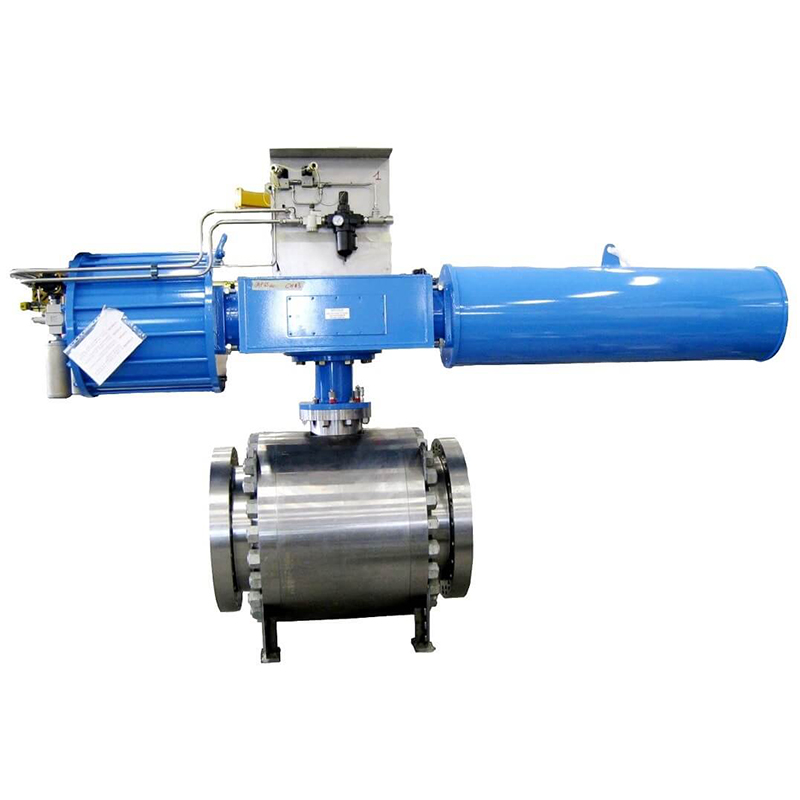
Pneumatic Actuator Valve
Chinese SDV Valve Manufacture and Factory with competitive Price, ShutDown Valve materials has Carbon Steel, Stainless Steel, Inconel, Hastelloy, Monel.

Pneumatic Actuator Ball Valve with Spring Return or Double Action Pneumatic Actuator, Factory price and Europe Quality to help you win instrument project.

Pneumatic Actuator Butterfly Valve can be made with Flange, Lug and Wafer Butterfly Valves. The pressure under Class 150 to 1500lb, contact us for data sheet.

As the source supplier of pneumatic gate valves, we have our own gate valve and pneumatic actuator factory. You will no need to worry about the high price.

A high-quality pneumatic actuator globe valve supplier from China, helping to achieve perfect control of automated fluids, we are your free system consultant.

Are you looking for a quality pneumatic chinese plug valve manufacturer, the pneumatic sleeve plug valves from NSW Valve factory will meet your requirements.
Types and Applications of Pneumatic Actuator Valves
China has emerged as a global hub for pneumatic valve manufacturing, with numerous China Pneumatic Actuator Valve manufacturers offering high-quality products at competitive prices. A Pneumatic Actuator Valve Factory in China typically combines advanced production technologies with strict quality control measures. For every Pneumatic Actuator Valve Supplier, it is essential to understand the distinct characteristics of each valve type. The following sections provide detailed analyses of the most commonly used pneumatic actuated valves.
Pneumatic Actuator Ball Valve
A Pneumatic Ball Valve combines a quarter-turn pneumatic actuator with a ball valve mechanism. The ball valve features a polished spherical closure member with a central bore; when the bore is aligned with the pipeline, flow passes through; when rotated 90 degrees, the solid ball surface blocks flow. Pneumatic ball valves are available with either double-acting or spring-return pneumatic actuators, and can be made from various materials including stainless steel (304/316), carbon steel, and special alloys such as Inconel, Hastelloy, and Monel.
Key Features:
- Quarter-Turn Operation: Requires only 90° rotation to fully open or close, enabling extremely fast actuation speeds of 0.05 seconds per operation.
- Tight Shut-Off: Exceptional sealing performance with virtually zero leakage due to the precise mating of ball and seat.
- Low Pressure Drop: Full-bore designs minimize flow resistance, making them highly efficient for fluid transportation.
- Versatile Material Options: Available in stainless steel, carbon steel, bronze, and specialized alloys to suit different media compatibility.
- High Durability: Designed for high-cycle applications with reliable performance over extended service life.
Primary Applications:
- Oil & Gas: Pipeline shutoff and flow isolation in upstream, midstream, and downstream operations.
- Chemical & Petrochemical: Handling corrosive fluids, acids, solvents, and reactive chemicals.
- Food & Beverage: Sanitary-grade ball valves for hygienic processing lines.
- Pharmaceutical & Biotech: CIP (Clean-in-Place) capable valves for sterile environments.
- Water & Wastewater Treatment: Efficient on/off control in distribution networks.
- Power Generation: Steam and cooling water control in thermal and nuclear power plants.
Comparative Analysis - Pneumatic Ball Valve vs. Butterfly Valve vs. Gate Valve:
Among different valve types, Pneumatic Ball Valves offer the highest sealing integrity and are ideal for applications requiring bubble-tight shut-off [2†L14]. Compared to gate valves, ball valves require only a quarter turn to open or close, allowing much faster operation than the multi-turn requirement of gate valves [2†L43-L47]. While butterfly valves are lighter and more compact, ball valves provide superior sealing performance and are better suited for high-pressure applications [2†L7-L11]. The closing tightness of globe valves may be better than gate valves, but ball valves offer the best combination of fast operation and reliable sealing across a wide range of conditions.
Selection Criteria for Pneumatic Ball Valves:
When selecting a pneumatic ball valve, consider the following factors:
• Process Media: Identify the type, temperature, pressure, and corrosiveness of the fluid.
• Connection Type: Choose from threaded, flanged, wafer, or welded connections.
• Actuator Type: Select between double-acting or spring return based on fail-safe requirements.
• Material Compatibility: Match valve body and seat materials to the process media.
• Torque Requirements: Ensure the actuator provides sufficient torque to overcome breakaway, running, and reseating forces.
Torque Considerations:
Proper torque sizing is critical for reliable pneumatic ball valve operation. Before sizing an actuator, check with the valve manufacturer for the valve’s torque requirements. The actuator’s break torque must exceed the valve’s maximum required torque by a safety factor of 25% or more, depending on the application and media characteristics.
Pneumatic Actuator Butterfly Valve
A Pneumatic Butterfly Valve consists of a pneumatic actuator mounted to a butterfly valve, where a circular disc (butterfly plate) rotates around a fixed axis perpendicular to the flow channel. When the disc is parallel to the flow direction, the valve is fully open; when rotated 90 degrees to block the flow path, it is closed. The pneumatic actuator drives the valve stem, which rotates the butterfly plate to achieve the enabling action.
Key Features:
• Compact and Lightweight: Simple structure with small size and light weight, ideal for applications with limited installation space.
• Low Cost: More economical than ball valves or gate valves, especially in larger diameters.
• Large Diameter Capability: Particularly suitable for low-pressure, large to medium diameter pipelines.
• Fast Operation: 90° rotation allows for rapid opening and closing with low flow resistance.
• Versatile Design Variations: Available in wafer, lug, and flanged configurations; with soft seal or hard seal options; in stainless steel, carbon steel, or cast iron materials.
• Adjustable Flow Control: When combined with a valve positioner, can achieve proportional adjustment and two-position cutoff control of fluid media.
Primary Applications:
• HVAC Systems: Efficient flow control in heating, ventilation, and air conditioning networks.
• Water Treatment: Large-diameter applications in municipal and industrial water facilities.
• Chemical Pipelines: Cost-effective solution for low to medium pressure chemical handling.
• Environmental Protection: Wastewater treatment and emissions control systems.
• Water Conservancy: Irrigation and flood control systems requiring large flow capacities.
• Heating and Plumbing: Building services and district heating networks.
• Food Processing: Sanitary butterfly valves for food and beverage production lines.

Comparative Analysis:
Pneumatic butterfly valves are distinguished by their compactness and cost-effectiveness. Their body length is small and flow resistance is minimal compared to gate or globe valves. However, butterfly valves generally have poorer sealing performance than ball valves and are not recommended for high-temperature or high-pressure environments where tight shut-off is critical.
Selection Criteria for Pneumatic Butterfly Valves:
• Pipe Size: Butterfly valves are most economical for diameters 2 inches and above.
• Pressure Rating: Typically suitable for Class 150 to 600; higher pressures may require other valve types.
• Seal Type: Soft seal (EPTFE, EPDM, Viton) for bubble-tight shut-off; hard seal (metal-to-metal) for high temperatures or abrasive media.
• Connection Style: Wafer for sandwich mounting between flanges; lug for dead-end service; flanged for permanent installations.
• Actuator Configuration: Double-acting for continuous operation; spring return for fail-safe requirements.
Torque Considerations:
Scotch-yoke actuators align particularly well with the torque needs of butterfly valves. From 0-20° and 20°-0, these actuators apply up to 50% more torque than during the remainder of the cycle, exactly when butterfly valves require additional force to unseat or reseat the disc.
Pneumatic Gate Valve
A Pneumatic Gate Valve integrates a pneumatic actuator with a gate valve mechanism, where a wedge-shaped gate moves vertically (linear stroke) to isolate or permit flow. These valves are primarily used for fully open or fully closed applications rather than throttling or flow regulation. The gate moves up and down perpendicular to the flow direction, effectively cutting off the medium like a gate, hence the name.
Key Features:
• Low Flow Resistance: When fully open, the gate is completely retracted, providing minimal obstruction to flow.
• Bi-Directional Sealing: Effective sealing in both flow directions.
• High-Pressure Capability: Suitable for high-pressure applications where other valve types may fail.
• Temperature Resistance: Can operate in high-temperature environments with appropriate material selection.
• Self-Sealing Design: The vast majority of gate valves are forced to close; when closed, force is used to press the gate against the seat to ensure sealing integrity.
• Visual Position Indication: Many pneumatic gate valves include spot indication of open and closed states via digital display instruments.
Primary Applications:
• High-Pressure Pipelines: Oil and gas transmission lines requiring reliable isolation.
• High-Temperature Systems: Steam and thermal fluid networks in power generation.
• Industrial Process Lines: Manufacturing facilities requiring full-bore, low-restriction flow.
• Water Distribution: Large-diameter water mains and treatment facilities.
• Refinery Operations: Critical isolation points in hydrocarbon processing.
Comparative Analysis:
Pneumatic gate valves offer the lowest flow resistance when fully open due to their straight-through design. However, they have slower operation than quarter-turn valves because the gate must travel vertically the full height of the passageway. Gate valves also require longer installation space due to their extended bonnet and stem length. When compared to pneumatic ball or butterfly valves, gate valves are best suited for applications where pressure drop is the primary concern and where fast operation is not required. A gate valve’s flow resistance is small and it offers good sealing performance.
Selection Criteria for Pneumatic Gate Valves:
• Pressure Class: Available from Class 150 to 2500 LB, suitable for extremely high-pressure applications.
• Material Selection: Carbon steel (WCB), stainless steel (CF8, CF8M), alloy steel (WC6, WC9), low-temperature carbon steel (LCB, LCC), and special alloys including Alloy 20, Monel, Inconel, and Hastelloy.
• End Connection Types: Flanged (RF, RTJ, FF) or butt-welded connections per ASME standards.
• Design Standards: Manufactured to API 600, API 603, ASME B16.34 with testing per API 598.
• Special Requirements: NACE MR-0175/MR-0103 for sour service; ISO 15848 for fugitive emissions; API 624 for low emissions.

Pneumatic Globe Valve
A Pneumatic Globe Valve combines a linear-stroke pneumatic actuator with a globe valve body, designed for precise flow regulation rather than simple on/off service. The globe valve features a disc that moves perpendicularly to the valve seat, allowing for accurate modulation of flow rates. A high-quality pneumatic actuator globe valve supplier from China can help achieve perfect control of automated fluids.
Key Features:
• Precise Flow Regulation: Excellent throttling capability for controlling flow, pressure, and temperature.
• Reliable Shut-Off: Good sealing performance when fully closed.
• Linear Flow Characteristics: Predictable flow response to actuator stroke.
• Robust Construction: Suitable for high-pressure drop applications where cavitation may be a concern.
• Pressure-Balanced Trim Options: Available for stable flow control across wide pressure ranges.
Primary Applications:
• Process Control: Chemical processing where precise flow modulation is required.
• Steam Systems: Pressure reducing stations and steam temperature control.
• Boiler Feedwater: Accurate regulation of feedwater flow to boilers.
• Fuel Gas Systems: Precise control of natural gas or LNG flow.
• Cooling Water Systems: Temperature control via flow modulation.
• Condensate Return Systems: Regulating condensed steam return flow.
Pneumatic Diaphragm Valve
Pneumatic diaphragm valves utilize a flexible diaphragm that contacts a weir or seat to control flow. They are particularly suited for sanitary and corrosive applications where the process media must not contact mechanical parts, ensuring zero leakage and contamination prevention.
Key Features:
• Contamination-Free Operation: Process media contacts only the diaphragm and valve body.
• Excellent Cleanability: Suitable for CIP (Clean-in-Place) and SIP (Sterilize-in-Place) procedures.
• Corrosion Resistance: Ideal for aggressive chemicals and acids.
• Bubble-Tight Shut-Off: Excellent sealing characteristics.
Primary Applications:
• Pharmaceutical Manufacturing: Sterile fluid handling and batch processing.
• Biotechnology: Cell culture media and bioreactor systems.
• Food & Beverage: Dairy, beverage, and food ingredient processing.
• Water Treatment: Chemical dosing and disinfection systems.
• Semiconductor Manufacturing: Ultra-pure water and chemical distribution.

Importance of Pneumatic Actuators in Actuated Valves
Pneumatic Actuator Types and Mechanisms
Understanding the various types of Pneumatic Actuators available is crucial for selecting the right assembly for each application. When working with a Pneumatic Actuator Valve Factory, the ability to choose the appropriate actuator mechanism directly impacts system performance and longevity
Scotch Yoke Pneumatic Actuator
Scotch Yoke Pneumatic Actuators employ a sliding yoke mechanism to convert linear cylinder motion into rotational output. The yoke features a slotted arm that engages with a pin on the rotating shaft, creating a mechanical advantage that changes throughout the stroke.
Advantages:
High Breakaway Torque: Provides maximum torque at the beginning and end of stroke, when valves need the most force to unseat or seal.
Superior for Large Valves: Ideal for high-torque applications where standard rack and pinion actuators are insufficient.
Optimized for Butterfly Valves: Torque curve closely matches butterfly valve requirements, with higher torque at initial movement and seating positions.
Heavy-Duty Construction: Designed for demanding industrial environments and high-pressure systems.
Disadvantages:
Limited to 90° Rotation: Cannot be used for multi-turn applications or 180°+ rotation needs.
Larger Footprint: Typically larger than rack and pinion designs for equivalent torque output.
Higher Cost: More complex manufacturing results in higher prices.
Applications: Scotch yoke actuators excel in large-diameter ball valves, high-pressure butterfly valves, and gate valves in oil & gas, petrochemical, and power generation facilities.

Rack and Pinion Pneumatic Actuator
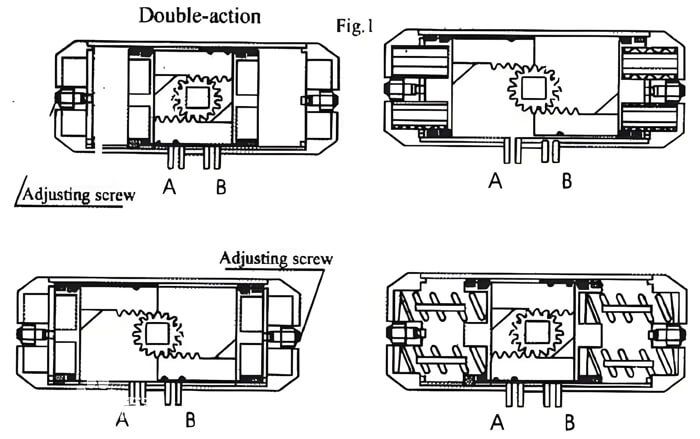
Rack and pinion Pneumatic Actuators are among the most widely used designs in industrial automation. As compressed air enters the actuator body, it pushes dual pistons linearly toward the cylinder ends. The pistons incorporate machined rack teeth that engage with a central pinion gear. As the pistons move, the racks force the pinion to rotate, converting linear motion into quarter-turn rotational output.
Advantages:
Constant Torque Output: Provides uniform torque throughout the entire 90° rotation.
Compact Design: Dual-piston arrangement minimizes actuator footprint relative to torque output.
Excellent Side Load Resistance: Superior ability to handle radial forces on the output shaft.
High Cycling Capability: Designed for millions of cycles in continuous duty applications.
Easy Integration: Standardized ISO 5211 mounting interfaces simplify valve attachment.
Disadvantages:
Lower Breakaway Torque: Requires higher air pressure for initial movement compared to scotch yoke designs.
Limited Torque Range: More suitable for smaller to medium valve sizes.
Applications: Rack and pinion actuators are ideal for ball valves and butterfly valves in water treatment, HVAC, food processing, and general industrial automation where consistent torque requirements across the stroke are preferred.
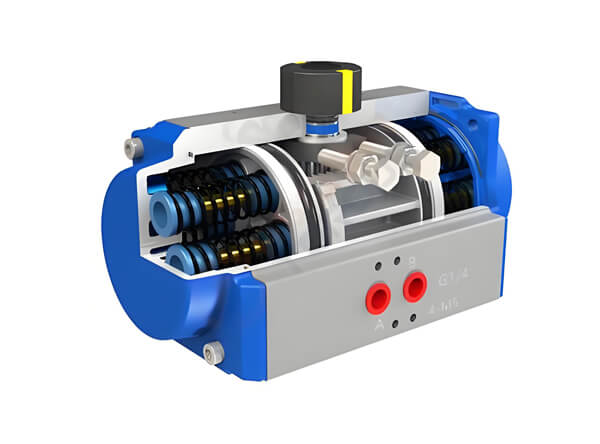
Diaphragm Pneumatic Actuator
Diaphragm Pneumatic Actuators use a flexible elastomeric diaphragm instead of a rigid piston to convert air pressure into linear motion. These are commonly used in control valve applications requiring precise positioning.
Advantages:
Smooth, Frictionless Motion: No sliding seals means reduced friction and hysteresis.
Excellent Sensitivity: Responds to very small pressure changes for fine control.
Low Maintenance: Fewer wear parts compared to piston designs.
Applications: Diaphragm actuators are primarily used with globe control valves and regulators in process control applications requiring precise modulation rather than on/off service.
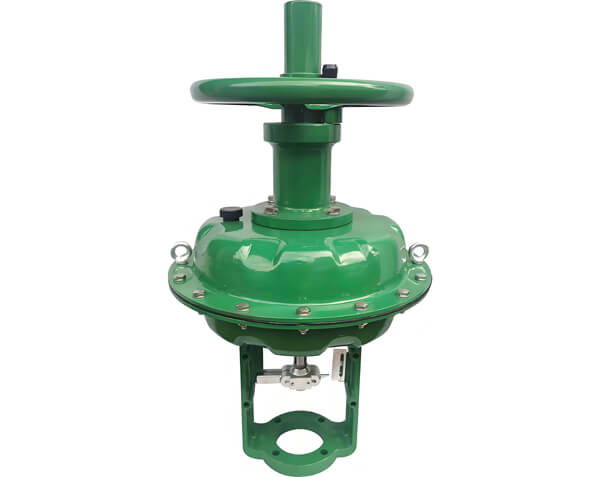
Stainless Steel Pneumatic Actuator
The cylinder body of the stainless steel pneumatic actuator is cast from stainless steel and is mainly used in corrosive environments. It is available in both single-acting and double-acting versions. Single-acting actuators automatically close when the air supply is shut off, while double-acting actuators control opening and closing independently through two separate air ports.
Advantages:
Because the valve body is made of stainless steel:
1. Stronger corrosion resistance – Ideal for harsh, corrosive operating conditions.
2. Higher pressure tolerance – The stainless steel housing of the actuator is stronger than an aluminum alloy housing, allowing it to withstand higher air supply pressures.

How to Select a Reliable Pneumatic Actuator Valve Supplier
Choosing the right Pneumatic Actuator Valve Supplier is a critical decision that affects system reliability, maintenance costs, and overall operational efficiency. Whether sourcing from a China Pneumatic Actuator Valve manufacturer or a domestic supplier, consider the following evaluation criteria:
1. Product Quality and Manufacturing Standards
Leading Pneumatic Actuator Valve Factory operations should demonstrate:
ISO 9001 Certification: Evidence of quality management systems throughout production.
Material Certifications: 3.1 or 3.2 mill test reports for all pressure-containing components.
Testing and Inspection: API 598 or equivalent testing protocols with documented results.
Advanced Production Equipment: CNC machining centers, automated assembly lines, and precision testing equipment.
High-quality suppliers should have advanced production equipment and strict quality control to ensure valve durability and reliability.

2. Technical Strength and Engineering Support
Prioritize manufacturers with strong R&D capabilities and extensive field experience. Technical strength should include:
In-House Engineering Team: Capability to provide customized solutions for specific applications.
Material Expertise: Knowledge of material selection for various media including corrosive chemicals, high temperatures, and cryogenic services.
Torque Calculation Capabilities: Ability to properly size actuators for specific valve torque requirements.
Certification Portfolio: ISO, CE, ATEX, SIL, API, and NACE certifications for global compliance.

4. Price Competitiveness
China has established itself as a premier global manufacturing hub for industrial valves. By sourcing directly from a China Pneumatic Actuator Valve manufacturer, buyers can achieve significant cost advantages.
Cost Benefits of China Sourcing:
Factory Direct Pricing: Elimination of intermediary markups reduces procurement costs by 30-50%.
Lower Manufacturing Costs: Competitive labor and material costs in China translate to affordable final products.
High Volume Capabilities: Chinese factories can accommodate large orders with economies of scale.

5. OEM and Customization Capabilities
Many applications require tailored solutions rather than standard catalog products. A reliable pneumatic actuator valve supplier should offer:
Custom Valve Assemblies: Engineered-to-order configurations for unique application requirements.
Fast Prototyping: Rapid turnaround for custom designs and modifications.
Branding Options: Logo casting, custom nameplates, and private labeling.
Flexible MOQ: Accommodation of both small pilot orders and large production runs.

6. Certifications and Compliance
Ensure your Pneumatic Actuator Valve Supplier maintains relevant certifications for your target markets and applications:
ISO 9001:2015: Quality management system certification.
CE Marking: Compliance with European safety standards.
ATEX: Certification for potentially explosive atmospheres.
SIL (Safety Integrity Level): Functional safety certification for critical applications.
API Standards: Compliance with American Petroleum Institute specifications.
NACE MR-0175/MR-0103: Compliance for sour service environments.

Working Principle of Pneumatic Actuator Valves
A Pneumatic Actuator operates by converting the potential energy of compressed air into mechanical motion. When compressed air is introduced into the actuator chamber, it pushes against a piston or diaphragm, generating linear or rotary movement. This mechanical motion is then transmitted to the valve stem, which opens, closes, or modulates the valve according to the control signal received. A pneumatic actuator valve is mainly composed of an actuator, valve body, and pneumatic actuator accessories such as solenoid valves, filter regulators, and positioners.
There are two primary configurations of pneumatic actuators:
Double-Acting Pneumatic Actuators: This configuration requires air pressure to both open and close the valve. Air is alternately supplied to two ports, driving the piston in both directions. Double-acting actuators provide full control over opening and closing speeds and are ideal for applications requiring continuous cycling.
Spring Return (Single-Acting) Pneumatic Actuators: Also known as fail-safe actuators, these use compressed air to move the valve in one direction while internal springs return the valve to its default position when air pressure is lost. Spring return actuators are critical for emergency shutdown applications where valve position must default to safe state upon system failure.
The movement can be classified as either linear stroke (for gate and globe valves) or quarter-turn rotary stroke (for ball and butterfly valves), with the most common rotary actuators utilizing either rack-and-pinion or scotch-yoke mechanisms.
How to Choose Pneumatic Actuator Valve Manufacturers and Suppliers
Pneumatic Actuator Valves Supplier
Product Quality: Choose manufacturers with advanced production equipment and strict quality control to ensure the durability and reliability of the valve.
Technical Strength: Give priority to manufacturers with R&D capabilities and rich experience, who can provide customized solutions.
After-sales Service: High-quality suppliers should provide comprehensive after-sales service, including technical support, repair and maintenance, etc.
Price Competitiveness: Under the premise of ensuring quality, choose manufacturers with reasonable prices to reduce procurement costs.

Pneumatic Actuator Valves are indispensable in industrial automation. Whether they are pneumatic valves, electric valves or hydraulic valves, they all have their unique advantages and application scenarios. Choosing reliable manufacturers and suppliers is the key to ensuring efficient operation of the system. If you are looking for high-quality actuator valves, pneumatic valves, electric valves or hydraulic valves, please contact us and we will provide you with the most competitive prices and the best services.